
Kitchen Cabinet Material Options: 2026 Homeowner's Guide

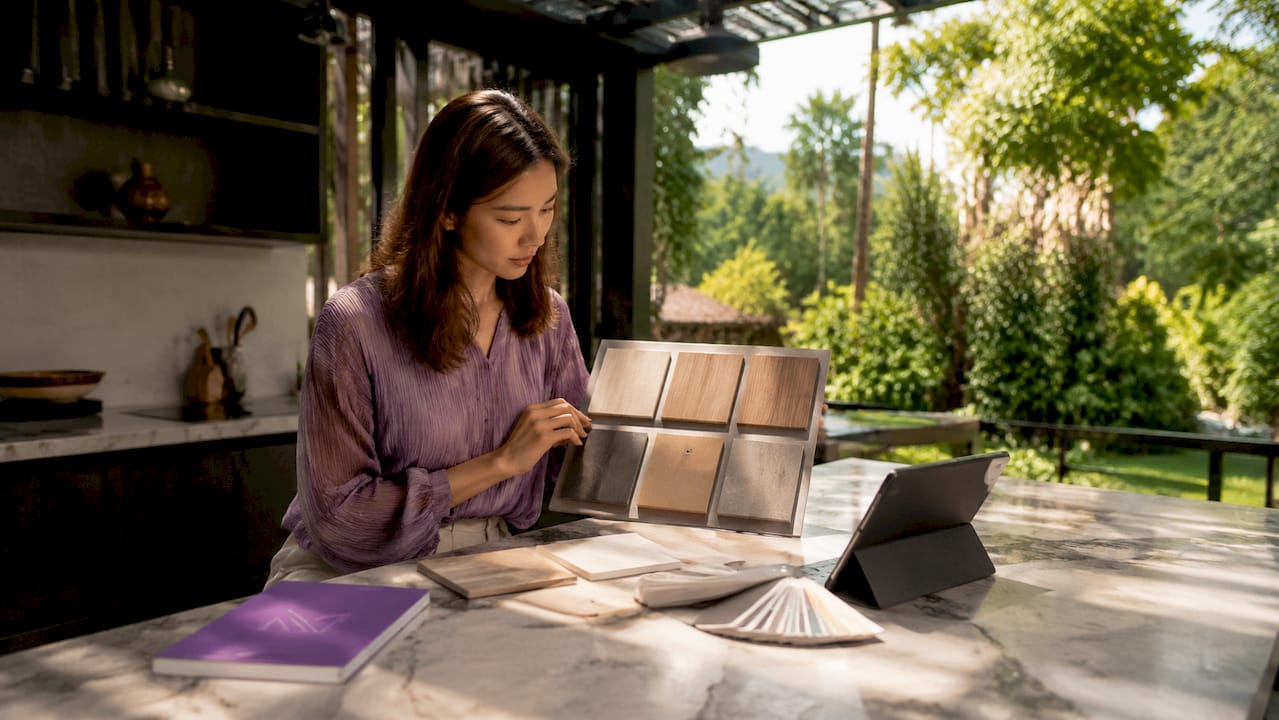
What are the best kitchen cabinet material options?
No single material wins across every part of a kitchen cabinet. The smartest builds use a combination: plywood for cabinet boxes, MDF for painted doors, and solid hardwood for stained doors and face frames. Each material has a specific role, and mixing them correctly is what separates cabinets that last decades from ones that fail in five years.
The table below gives you a direct comparison of the most common kitchen cabinet material options across the factors that matter most.
Material | Durability | Cost | Aesthetics | Moisture Resistance | Maintenance | Best Use |
Solid Wood | Very High | Premium | Natural grain, warmth | Moderate | Refinishable | Stained doors, face frames |
Plywood | High | Mid–High | Clean, layered | High | Low | Cabinet boxes, shelving |
MDF | Moderate | Mid | Smooth, paint-ready | Low | Low | Painted doors, panels |
Particleboard | Low | Budget | Flat | Very Low | Moderate | Light-use interiors |
Wood Veneer | Moderate–High | Mid | Real wood look | Moderate | Low | Doors, drawer fronts |
Laminate/Thermofoil | Moderate | Budget–Mid | Wide color range | Good | Very Low | Budget kitchens, overlays |
Melamine | Moderate | Budget | Matte or gloss | Good | Very Low | Cabinet interiors |
Acrylic | Moderate | Mid–High | High gloss, vibrant | Good | Low | Modern slab doors |
Bamboo | High | Mid | Unique, eco-friendly | Moderate | Low | Specialty, eco builds |
Stainless Steel | Very High | Premium | Industrial, sleek | Excellent | Low | Commercial, wet zones |
Key trade-offs at a glance:
Solid wood offers unmatched beauty for stained finishes but moves with humidity, making it unsuitable for full box construction.
Plywood resists moisture and holds screws better than MDF or particleboard, which is why it dominates quality cabinet box construction.
MDF’s grain-free surface makes it the top choice for painted doors, but it cannot tolerate prolonged water exposure.
Particleboard is the most affordable substrate but performs poorly in moisture-heavy environments like kitchens.
Laminates and thermofoil deliver easy-clean surfaces at lower cost, though they lack the repairability of wood-based options.
1. Solid wood and plywood: why they lead in premium cabinetry
Solid wood and plywood occupy different roles in a well-built cabinet, and understanding that distinction saves you from expensive mistakes.
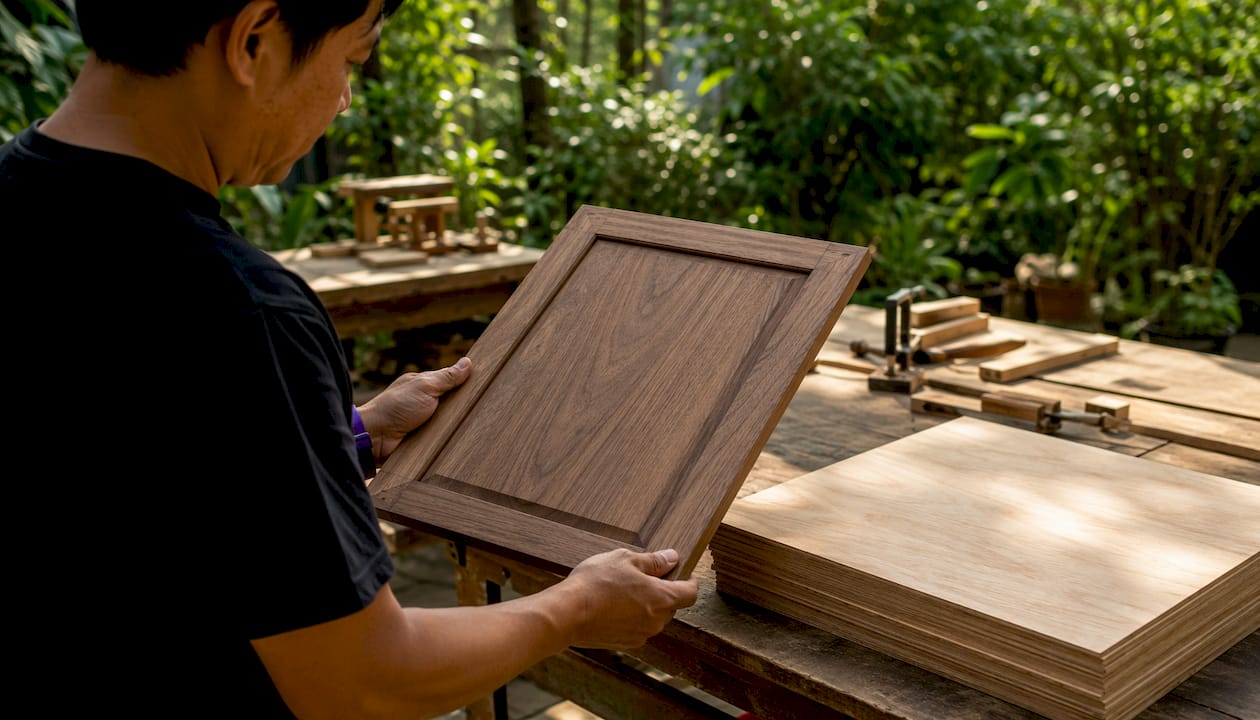
Solid wood earns its place on doors, face frames, and drawer fronts. Species like maple, cherry, white oak, and walnut each carry distinct grain patterns and color depth that stain brings to life. Maple offers a fine, controlled grain ideal for contemporary kitchens; white oak has become a favorite for warmth without feeling traditional; cherry deepens in color over time. Solid wood can also be sanded and refinished multiple times, giving it a lifespan of 30–50 years in quality builds.
Where solid wood falls short is in full box construction. Wood expands and contracts with seasonal humidity changes, which weakens joints over time and can cause wide panels to warp or crack. Plywood, built from alternating veneer layers, is dimensionally stable in a way solid lumber simply is not.
Plywood is the industry standard for cabinet boxes, and for good reason. It holds screws better than MDF or particleboard, resists moisture without permanent swelling, and survives the daily stress of heavy loads and hardware cycling. Plywood boxes cost 20–40% more than particleboard alternatives, but the longevity difference justifies that premium in any kitchen that sees real use.
Pros and cons summary:
Solid wood: beautiful grain, refinishable, long-lived. Moves with humidity; not ideal for boxes.
Plywood: strong, stable, moisture-tolerant. Costs more than particleboard; edge layers need finishing.
Pro Tip: Always specify furniture-grade plywood, not construction-grade. Construction-grade panels can have internal voids that weaken screw-holding capacity, leading to hinge and hardware failures over time.
2. Engineered wood options: MDF, particleboard, and wood veneer
These three materials cover a wide range of budgets and applications, and each has a legitimate place in cabinetry when used correctly.
MDF (Medium-Density Fiberboard)
MDF is made from wood fibers compressed with resin into a dense, grain-free panel. That smooth, uniform surface is its defining strength. MDF does not suffer from seasonal movement the way solid wood does, which means painted finishes stay flawless over time without grain lines telegraphing through the paint. For any painted cabinet door or panel, MDF is the better choice over solid wood.
Its weakness is moisture. MDF swells when it gets wet and does not recover the way plywood does. Proper sealing on all six sides, including edges, is non-negotiable in kitchen applications.
Best for: Painted doors, drawer fronts, end panels
Avoid for: Cabinet boxes, areas near sinks or dishwashers without full sealing
Particleboard
Particleboard is the lowest-ranked material for kitchen cabinet boxes. It is heavier than plywood, weaker, and absorbs moisture more readily than either plywood or MDF. Production cabinets use it because it is cheap, not because it performs well. In a kitchen with any meaningful moisture exposure, particleboard boxes are the first component to fail.
That said, particleboard with a TFL (thermally fused laminate) surface is acceptable for interior shelving in dry, low-use areas where weight loads stay light.
Best for: Adjustable interior shelves in dry spaces, budget utility storage
Avoid for: Kitchen cabinet boxes, sink bases, any moisture-prone zone
Wood veneer
Wood veneer gives you the look and feel of real wood at a fraction of the cost of solid lumber. A thin slice of genuine wood, typically birch, maple, walnut, or white oak, is bonded to a stable substrate like plywood or MDF. The substrate provides dimensional stability; the veneer provides the visual character. Veneer thickness matters: thick veneer over quality plywood is a premium product, while paper-thin veneer over particleboard degrades quickly.
Best for: Doors, drawer fronts, and box exteriors where visual quality matters
Avoid for: High-impact areas where the thin face layer can chip or peel
3. Laminates, thermofoil, melamine, acrylic, and specialty materials
These surface-focused materials prioritize finish, maintenance, and budget over raw structural performance. They work best when applied over a solid substrate.
Laminates and thermofoil are among the most practical options for homeowners who want easy-clean surfaces without the cost of solid wood. Laminates and thermofoil provide budget-friendly, durable finishes that resist scratches and stains, making them well-suited to busy family kitchens. High-pressure laminate (HPL) is the more durable variant, pressed at high pressure for superior impact resistance. Thermofoil wraps a vinyl film around an MDF core, creating a seamless look that works well for modern slab-door styles.
Laminates: Wide color and texture range, scratch-resistant, easy to clean. Less repairable if damaged.
Thermofoil: Seamless finish, budget-friendly. Can peel near heat sources over time.
Melamine is a resin-coated surface fused to a substrate, usually particleboard or MDF. It is the standard finish for cabinet interiors across most price points, and for good reason: it is pre-finished, easy to wipe clean, and cost-effective. Melamine works well for cabinet interiors where visual impact is secondary to practicality.
Acrylic panels deliver a high-gloss, mirror-like finish that suits contemporary and minimalist kitchens. They resist fingerprints and scratches better than standard paint, and the color depth is vibrant. The trade-off is cost: acrylic sits in the mid-to-premium range and requires careful handling during installation to avoid surface scratches.
Specialty materials serve specific needs:
Bamboo: A fast-growing, renewable material with hardness comparable to many hardwoods. It suits eco-conscious builds and adds a distinctive visual texture. Moderate moisture resistance makes it viable for kitchen doors with proper finishing.
Stainless steel: The material of choice for commercial kitchens and serious home cooks. Exceptional moisture and heat resistance, fully hygienic, and nearly indestructible under normal use. The cost is premium, and the aesthetic is distinctly industrial.
4. How to choose the right kitchen cabinet material for your kitchen
The right choice depends on four variables: moisture exposure, usage intensity, budget, and desired finish. Getting these right before you commit to a material saves costly rework later.
Start with your kitchen’s moisture environment. A high-traffic kitchen with a busy sink, a dishwasher, and regular steam from cooking needs plywood boxes as a baseline. High-traffic, moist kitchens benefit from plywood boxes, while drier or budget kitchens can reasonably use particleboard or MDF with proper finishes. If you have a secondary or guest kitchen with light use, MDF or laminate-faced particleboard may be entirely adequate.
Then decide on your finish. This single decision drives most of your material choices downstream. Painted cabinets call for MDF doors on plywood boxes with hardwood face frames. Stained cabinets require solid hardwood doors and face frames on plywood boxes. Mixing these up, such as using solid wood doors on a painted finish, leads to grain lines appearing through paint over time.
Budget allocation checklist:
Prioritize plywood for cabinet boxes. This is the structural foundation; do not compromise here.
Use MDF for painted doors and panels to get the smoothest possible finish at lower cost than solid wood.
Reserve solid hardwood for stained doors, face frames, and drawer fronts where grain visibility matters.
Laminate or melamine interiors are a smart cost-saving move that funds better materials on the exterior.
Particleboard is acceptable only for adjustable interior shelving in dry zones with light loads.
Consider your timeline. If you plan to stay in the home long-term, the 20–40% premium for plywood over particleboard pays for itself in avoided repairs and replacements. If you are renovating a rental or a property you plan to sell within a few years, a well-finished laminate or melamine build may be the more practical investment.
Pro Tip: Ask any cabinet contractor specifically what material the boxes are made from. If the answer is particleboard or “furniture board,” you are getting the budget tier regardless of how premium the doors look. Plywood boxes are the baseline for quality residential cabinetry.
5. Expert insights from Monarch carpenters on material combinations in 2026
At Monarch carpenters, the approach to material selection starts with a straightforward principle: no single material belongs everywhere in a cabinet. The best builds are deliberate combinations, with each component matched to its function and finish type.
The team at Monarch carpenters consistently recommends combining plywood boxes with MDF painted doors and solid hardwood face frames as the baseline for quality residential cabinetry. This combination delivers structural integrity where it matters most, a flawless painted surface where aesthetics are the priority, and the screw-holding strength that face frames demand from daily hinge cycling. For clients who want stained cabinetry, solid hardwood doors replace MDF, and the grain selection becomes part of the design conversation.
One area where Monarch carpenters sees clients make costly mistakes is in plywood grade. Furniture-grade plywood with consistent thickness and minimal internal voids is a different product from construction-grade material. Using construction-grade plywood can result in voids that weaken screw-holding capacity, leading to hardware failures over time. The grade difference is not always visible from the outside, which is why asking for specifications matters.
Budget trade-offs are real, but they do not have to compromise performance. Monarch carpenters’ experience with clients across residential and hospitality projects shows that investing in stronger cabinet boxes and better hardware first, then aligning visible finishes with the available budget, consistently delivers better long-term value than the reverse. A kitchen with plywood boxes and laminate doors outperforms one with particleboard boxes and solid wood doors every time.
What the team at Monarch carpenters recommends for 2026 builds:
Furniture-grade plywood for all cabinet boxes, especially in kitchens with active cooking and sink proximity.
MDF for painted door fronts; properly sealed on all six sides to guard against edge moisture.
Solid hardwood (maple or poplar for painted face frames; maple, white oak, or walnut for stained) on face frames and stained doors.
Melamine or TFL interiors to keep costs down without affecting the visible quality of the finished kitchen.
Acrylic or matte laminate slab doors for clients seeking a contemporary, low-maintenance aesthetic at a reasonable price point.
Clients who have worked with Monarch carpenters on kitchen renovations consistently highlight the balance between design quality and cost. The studio’s collaborative process, where designers and carpenters work together from concept through installation, means material decisions are made with both the visual outcome and the long-term performance in mind. You can explore how this approach applies to your space through Monarch carpenters’ kitchen cabinet customization guide for a detailed look at how material choices translate into finished kitchens.
For homeowners planning a full renovation, the kitchen renovation planning checklist from Monarch carpenters walks through material selection alongside layout, budget allocation, and contractor questions in a single structured resource.
Monarch carpenters brings great design to your kitchen at a modest cost
Choosing the right cabinet materials is only half the equation. The other half is working with a team that knows how to apply those materials well, without inflating the budget unnecessarily.

Monarch carpenters is a design and carpentry studio that has built a reputation for delivering kitchens that look and perform like premium builds, at a price point that surprises clients in the best way. The studio’s in-house team of designers and carpenters handles every stage collaboratively, from material specification through final installation, which eliminates the miscommunication and cost blowouts that come from coordinating separate contractors. Clients consistently highlight the quality of the finished work and the transparency of the process, noting that Monarch carpenters delivers elegant, durable results without the premium price tag that bespoke carpentry often carries.
Whether you are planning a full kitchen renovation or replacing cabinetry in a specific zone, the team at Monarch carpenters will walk you through the right material combination for your space, your finish goals, and your budget. Get in touch with Monarch carpenters to discuss your project and see how far a well-planned material strategy can take your kitchen.
FAQ
What type of material is best for kitchen cabinets?
No single material is best for every part of a cabinet. Quality builds use plywood for boxes, MDF for painted doors, and solid hardwood for stained doors and face frames, with each material matched to its function.
Is MDF or plywood better for kitchen cabinets?
Plywood is better for cabinet boxes because it holds screws well and resists moisture without permanent swelling. MDF is better for painted doors because its grain-free surface keeps paint finishes smooth and crack-free over time.
What are the three grades of cabinets?
The three grades are stock, semicustom, and custom. Stock cabinets are pre-built and available immediately at lower cost; semicustom offers more size and finish options; custom cabinets are built to exact specifications and typically use superior joinery like dovetails and mortise-and-tenon construction.
What is the newest trend in kitchen cabinet materials?
Acrylic high-gloss and matte UV-lacquer finishes are among the most current choices for contemporary kitchens, offering strong scratch and fade resistance. Newer options like PET panels and nano-technology super-matte surfaces are also gaining traction for their anti-fingerprint performance and durability.
Key Takeaways
Plywood boxes combined with MDF painted doors and solid hardwood face frames deliver the best balance of structural durability, finish quality, and long-term value for most residential kitchens.
Point | Details |
Plywood leads for cabinet boxes | Plywood costs 20–40% more than particleboard but provides superior moisture resistance and screw-holding. |
MDF is best for painted doors | MDF’s grain-free surface prevents paint cracking and keeps finishes smooth over decades of use. |
Solid wood belongs on stained components | Hardwood doors and face frames showcase natural grain; avoid using solid wood for full box construction. |
Avoid particleboard in wet zones | Particleboard absorbs moisture and weakens faster than plywood or MDF in active kitchen environments. |
Monarch carpenters combines materials strategically | The studio pairs furniture-grade plywood boxes with MDF or hardwood fronts to deliver elegant kitchens at modest cost. |
Recommended
Comments